R2A Review - A wrap of Engineering Due Diligence


Welcome to our final newsletter for 2025. 

As many of you would know, one of R2A’s primary areas of focus is the So Far As Is Reasonably Practicable (SFAIRP) provisions of the WHS/OHS Acts, and the best way to go about demonstrating compliance with it.  We note that the SFAIRP provisions of the OHS Act in Victoria has been in place since 2004 and in most jurisdictions since 2012, with WA the last state to enact it in 2022. 

The intent of the legislation was to create harmonisation in the Australian safety space.  However, R2A have observed over the last few years that there has been increasing divergence between the different jurisdictions as to what SFAIRP purports to be and how compliance should be demonstrated. This confusion is in part due to the sheer volume of information being generated, much of which is contradictory, including information provided by regulators and advice from lawyers. 

Safe Work Australia is currently undertaking a best practice review of the WHS legislation in the context of strengthening and maintaining harmonisation of WHS laws (see https://consult.swa.gov.au/best-practice-review).  R2A provided a response from an engineering perspective and the difficulties technical organisations are having around the practical implementation of WHS/OHS laws.  

The core concerns were:

  • Contradictions between the WHS Code of Practice and its enabling WHS legislation.
  • Contradictions with the hierarchy of control as promoted by the WHS Act (2), the common law (3) and safety regulators which seem to vary between four to six, coupled with confusion over the fundamental nature of engineering controls.
  • The ongoing non-alignment between planning law and safety law.

R2A’s full submission can be viewed on the safe work Australia website: https://consult.swa.gov.au/best-practice-review/bprsurveysubmissions/view/90

Along with our consulting and training / education work, Richard and I have enjoyed delivering another two seasons of our podcast this year.  To our very great surprise we had our 5000th download during the year!  It is great to be able to talk through and share some of our insights with our audience via this medium. Thank you for listening and the kind feedback we are receiving.  The podcast will continue in 2026.

With the festive season fast approaching, the R2A office will be closed from CoB Friday 19th December and will re-open on Monday 12th January.  Richard and I wish you and your loved ones a happy holiday season and all the very best for 2026.

Until next time,
Gaye Francis
R2A Partner


LIVE FORUM WRAP-UP


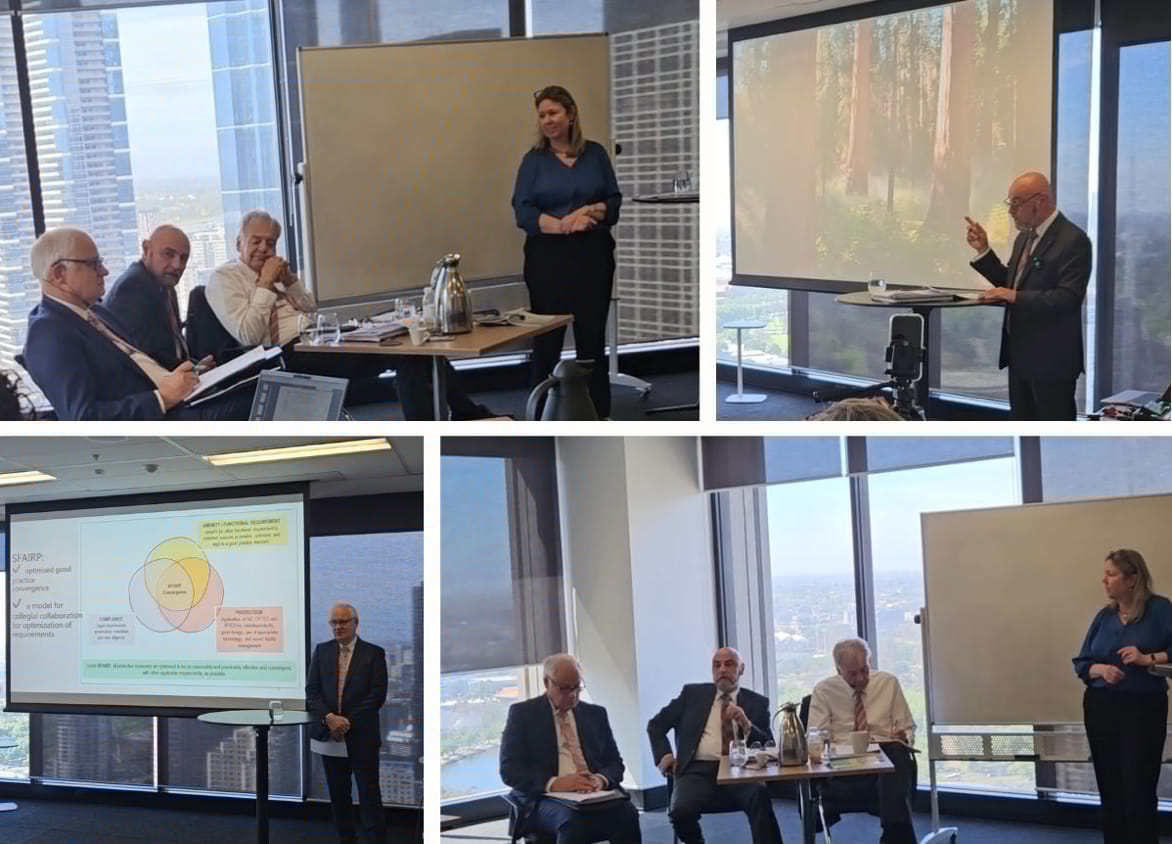
On Tuesday 21st October, R2A held our first live forum; Preventing Criminal Manslaughter - Understanding and implementing SFAIRP.

The forum extended on our podcast Risk! Engineers talk Governance, some of the questions we have been asked, and comments and feedback that has been provided over the last 6 seasons.

Presentations were provided from Richard, who set the context of the forum and talked about law as engineering, paraphrasing Cambridge Professor David Howarth’s book Law as Engineering. The second presentation was from Joseph Coleiro who is an Australia legal practitioner and covered WHS legal duties. The third presenter was Dr Frank Stoks, a retired architect from New Zealand, who provided a case study addressing the practicality of addressing laws of nature.

There were a number of key take-aways from the event. 

  • Firstly, for safety, SFAIRP is the legal duty and organisations are required to understand and demonstrate it.  Joseph outlined and explained the three components of SFAIRP:
    • SO FAR - This means going ‘so far’ as you can go to implement preventative controls, not ‘as low’ or ‘as far’ as you want.
    • AS IS - This means what you knew at the time of and leading up to the incident including decisions that underpin the incident. 
    • REASONABLY PRACTICABLE - This is as defined in the WHS/OHS legislation

      Richard’s blog (see below) details this further.
  • Frank's presentation’s take-away  — a case study —  on managing the laws of nature in the context of a Wellington Harbour drowning and associated SFAIRP design failures,  was around the importance of understanding the context and the desired outcome. For example, the solution must be safe, compliant and functionally appropriate.  This requires wide consultation with relevant (competent/expert) stakeholders to achieve the optimum solution.

Following morning tea, there was a panel question and answer session that resulted in some very interesting discussion which continued into lunch (for those in-person).

Richard and I would like to thank everyone who joined us in person and online, and for the wonderful feedback we’ve received. We will definitely consider running another event in the future.


NEW ARTICLE
The Breakdown of SFAIRP: SF - AI - RP


One of the biggest take-aways from the Live Forum was from Legal Practitioner Joseph Coleiro and how he broke down SFAIRP into three sections: So Far, As Is and Reasonably Practicable.

Richard has delved into this in his latest article which you can read via the link below. Richard and Gaye also discussed it in a recent podcast episode if you’d prefer to listen to their chat.


READ ARTICLE


LISTEN TO PODCAST EPISODE


RISK! ENGINEERS TALK GOVERNANCE

Podcast


Thank you to everyone who has contributed to 5,000 downloads of our Risk! Engineers Talk Governance. It’s quite staggering to us to see these stats and we are so appreciative that people tune in.

We have just wrapped up Season 6 and our theme of SFAIRP Complexities. Topics included: Rail Safety Pressures, Safety & Planning Law Complications, Could vs Should, What is a Formal Safety Assessment, Safe Work Australia’s Best Practice Review, Safety Culture Revisited, Two Types of Regulators. There was also a couple of special episodes, including Psychosocial Hazards with the introduction of the new Victorian Regulation.

Watch out for Season 7 in early 2026. 


PODCAST EPISODES & INFORMATION


IN HOUSE BRIEFINGS & WORKSHOPS 

In partnership with EEA


While public workshops are yet to be locked in, please note we run in-house briefings and workshops, tailored to your organisation’s needs. These can be be organised direct with us or through Engineering Education Australia (Engineers’ Australia).


IN-HOUSE BRIEFING INFO


BOOKLET
Due Diligence Essentials for Engineers


Earlier this year we published a new booklet: Risk Management & Negligence; Due diligence Essentials for Engineers booklet.

This booklet has been written for engineers in the age of engineer registration and the rise of criminal liability for designers. It specifically covers the legal context and environment in which engineers have to work, as well as the tools and techniques that can be used to solve complex issues and help demonstrate due diligence.

Find further information and purchase via the below link. The store also has various bundles of our books.


BOOKLET INFO & PURCHASE


Facebook 
 
LinkedIn


Direct Mail for Mac This email is powered by Direct Mail for Mac. Learn MoreReport Spam